

If you’ve spent any time chasing salmon and steelhead on Pacific Northwest rivers, you’ve heard anglers swear by Simons spinners. These aren’t your average fishing spinners. They’re purpose-built, blade-heavy weapons designed to trigger strikes from fish that have seen every lure in the box. But a lot of anglers grab one, make a few casts, and walk away frustrated. The problem isn’t the lure. It’s the approach. This guide breaks down everything you need to know about Simons fishing lures: the right sizes, color patterns, proven techniques, and the gear setup that makes them actually work.
Table of Contents
- Key Takeaways
- Simons spinners: sizes, blades, and color patterns
- Proven techniques for fishing with Simons spinners
- Common mistakes that kill your spinner fishing results
- Gear and tackle setup for Simons spinners
- My honest take on fishing Simons spinners
- Gear up with Highclasstackleco
- FAQ
Key Takeaways
| Point | Details |
|---|---|
| Size matters by species | Use size 4-5 spinners for Chinook salmon and size 3-4 for Coho for best vibration and depth. |
| Match color to water clarity | Silver for clear water, copper and brass for stained water, bright UV colors for low visibility conditions. |
| Feel the blade rotation | If your rod tip doesn’t pulse with blade vibration, your spinner is fouled or dead in the water. |
| Technique beats brand loyalty | Mastering retrieval speed and covering water produces more fish than chasing any single lure name. |
| Comply with local hook rules | Many rivers require single hooks for salmon and steelhead, so rig your spinners accordingly before you fish. |
Simons spinners: sizes, blades, and color patterns
Not all Simons spinners are built the same, and picking the wrong size for your target species is one of the fastest ways to go home empty-handed. Size 4-5 spinners produce optimal vibration and depth for Chinook salmon, while sizes 3-4 are preferred for Coho. That size difference isn’t arbitrary. Larger blades push more water, create more thump, and get down to the depth where big Chinook hold in heavy current.
The Simons 3.5 Colorado blade is one of the most talked-about options in the lineup. The 3.5 Colorado blades come in premium plating options including gold, silver, and copper, plus bright UV paints designed to maximize flash and vibration in low-light or stained conditions. Colorado blades spin at a wider angle than willow-leaf blades, which means they generate more resistance and more thump at slower retrieval speeds. That’s a big deal in cold water when fish are sluggish and you need the spinner to work hard even at a crawl.
Color selection is where a lot of anglers overthink it. The rule is simple. Silver or natural finishes work best in clear water, brass and copper perform in slightly stained conditions, and bright UV colors are your go-to when visibility drops. If you’re fishing a glacial river with green tint, a copper blade with an orange body is going to outperform a silver blade every single time.
Here’s how the main Simons spinner options stack up against general spinner categories for salmon and steelhead:
| Feature | Simons 3.5 Colorado | Standard inline spinners |
|---|---|---|
| Blade type | Colorado (wide angle) | Varies (willow, French, Colorado) |
| Plating options | Gold, silver, copper | Limited, often single finish |
| UV paint | Yes | Rarely |
| Best use | Stained to clear water | Clear to moderate conditions |
| Vibration level | High | Moderate |
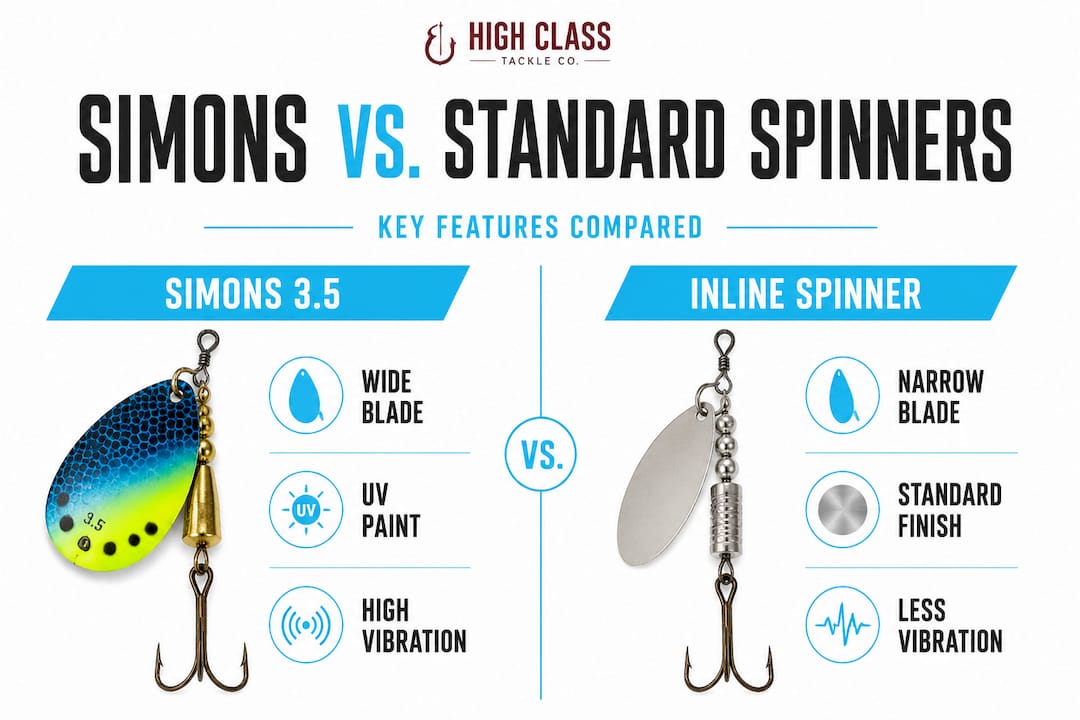
The UV paint on Simons fishing lures is worth calling out specifically. On overcast days or during early morning low-light windows, UV-enhanced blades can be the difference between getting bit and getting skunked. Fish use their lateral line to detect vibration, but their eyes still matter. UV flash gives them a visual trigger even when the sun isn’t cooperating.
Pro Tip: Carry at least three blade colors when you hit the river. Water conditions change fast in the Pacific Northwest, and the spinner color that crushed fish at 8 a.m. might be invisible by noon when the light angle shifts.
Proven techniques for fishing with Simons spinners
Knowing how to use spinners correctly is where most anglers separate themselves from the crowd. You can have the best Simons fishing lures in your box, but if your technique is off, you’re just decorating the river bottom.
The two most effective methods for river fishing with Simons spinners are bottom bouncing and cross-current swinging. Bottom bouncing involves casting upstream with a high rod tip and a faster initial retrieve to get the spinner down quickly, then slowing your retrieve to keep it ticking just above the bottom without snagging. It takes some practice to dial in, but once you feel the difference between a blade spinning clean and a blade dragging gravel, it clicks fast.
Cross-current swinging works especially well for steelhead. Cast quartering downstream, let the current swing the spinner across the run, and control the speed with your rod tip angle. Steelhead often smash the spinner right at the end of the swing when it slows and rises in the water column. That moment of hesitation triggers the predatory instinct hard.
Here’s a step-by-step breakdown for working a river run with Simons spinners:
- Read the water first. Identify seams where fast and slow water meet. Salmon and steelhead stack in these zones to rest without fighting heavy current.
- Cast upstream or quartering upstream. Give the spinner time to sink before the blade starts spinning.
- Keep your rod tip high and feel for blade rotation. If your rod tip doesn’t pulse with the blade’s rhythm, the spinner is fouled or in dead water. Adjust immediately.
- Vary your retrieve speed. Speed up through fast water, slow down in the soft seams where fish hold.
- Cover the entire run systematically. Start at the head of the run and work downstream in steps, fan-casting to cover every lane.
- Pause and twitch occasionally. A brief hesitation in the retrieve can trigger a strike from a fish that’s been tracking the spinner.
For trolling in lakes or tidal water, Simons spinners shine when you keep boat speed between 1.5 and 2.5 mph. Faster than that and the blade spins erratically. Slower and it dies. Check your rod tip constantly to confirm blade action.
Pro Tip: In cold water below 45°F, slow your retrieve down significantly. Fish metabolism slows in cold conditions, and a spinner burning past them at summer speed won’t get a second look. Let the blade barely tick and stay in the strike zone longer.
Common mistakes that kill your spinner fishing results
Even experienced anglers make these errors. Fixing them can turn a slow day into a memorable one.
The biggest mistake is ignoring water conditions when choosing blade size. Larger blades create the vibration needed in murky or deep water, while smaller blades work better in clear, shallow, slow-moving water. Fishing a size 5 blade in a clear low-water summer run is going to spook fish, not attract them. Scale down and go natural.
Other common pitfalls include:
- Fishing too fast in slow water. The blade needs current resistance to spin. In slack water, you have to supply that resistance with your retrieve speed. Most anglers don’t retrieve fast enough and the blade dies.
- Ignoring hook regulations. Many areas require single hooks for salmon and steelhead to protect fish populations. Fishing a treble-hooked spinner in a single-hook-only zone isn’t just illegal. It can harm fish you intend to release.
- Giving up on a run too quickly. Salmon and steelhead can be stubborn, and persistence in covering water and varying retrieval speeds is critical to success. Work a run thoroughly before moving on.
- Blaming the lure instead of the technique. Brand loyalty matters less than keeping the spinner blade spinning consistently throughout the retrieve. A fouled blade catches nothing, regardless of how premium the lure is.
- Not matching spinner weight to current speed. Light spinners get blown off course in heavy current. Use heavier bodies in fast water to maintain the right depth and angle.
Pro Tip: If you’re getting follows but no strikes, try stopping your retrieve completely for one second, then resuming. That sudden change in action often triggers a reaction bite from a fish that’s been trailing but not committing.
Gear and tackle setup for Simons spinners
The right rod, reel, and line setup makes Simons spinners perform the way they’re designed to. Fishing them on the wrong gear is like putting premium fuel in an engine that needs a tune-up first.
For river fishing, a medium-light to medium-action spinning rod in the 8.5 to 10-foot range gives you the casting distance and sensitivity to feel blade rotation clearly. Pair it with a quality spinning reel loaded with 10 to 15-pound monofilament or fluorocarbon. Fluorocarbon is nearly invisible underwater and has less stretch than mono, which improves strike detection. Check out this steelhead line guide for a deeper breakdown on line selection for PNW conditions.
Key tackle components to pair with your Simons spinners:
- Single siwash hooks. Swap treble hooks for single siwash hooks on any water requiring single-hook tackle. They’re also better for catch-and-release because they’re easier to remove cleanly.
- Beads. A small bead between the spinner body and the hook protects the knot from the blade’s clevis and reduces line twist.
- Barrel swivels. Attach a barrel swivel 18 to 24 inches above the spinner to prevent line twist from blade rotation. Line twist is the silent killer of spinner fishing. It weakens your line and kills your presentation.
- Snap swivels for quick changes. When you’re covering water and testing different colors, snap swivels let you swap spinners in seconds without retying.
- Split shot or inline weights. In fast, deep water, add a small split shot 12 inches above the spinner to get it down without switching to a heavier lure.
For a ready-to-fish spinner option built for steelhead, the Steelhead Slammer in electric green and brass is a hard-hitting choice that complements Simons tackle perfectly. You can also explore spinner blade performance details to understand how blade geometry affects action at different speeds.
Always check your local regulations before rigging. Hook rules, weight restrictions, and bead color regulations vary by river system and season. Staying legal protects the fishery and keeps you on the water.
My honest take on fishing Simons spinners
I’ve watched a lot of anglers buy the best spinners for fishing and then struggle to catch fish with them. They blame the lure. I’ve been there too. What I’ve learned after years on Pacific Northwest rivers is that technique consistently outweighs gear brand when it comes to salmon and steelhead.
Simons spinners are genuinely quality gear. The blade construction, the plating, the UV finishes. They’re built to perform. But I’ve seen anglers catch fish on beat-up spinners they found in a tackle box because they understood the water. They knew where fish were holding, they felt the blade rotation on their rod tip, and they had the patience to work a run properly.
My biggest lesson: slow down. Most anglers retrieve too fast. Cold water fish need the spinner in their face longer. The moment I started treating retrieval speed as a variable to control rather than a constant, my catch rate went up. That tactile feedback from the rod tip telling you the blade is spinning clean is worth more than any color choice.
Don’t let lure obsession replace water reading. Use Simons spinners as the tool they are, and put your energy into understanding where fish hold and how they’re behaving that day.
— Nick
Gear up with Highclasstackleco
If you’re ready to put these techniques to work, Highclasstackleco has you covered. We carry Simons spinners and a full lineup of complementary tackle built specifically for Pacific Northwest salmon and steelhead fishing.
From premium blades and rigging components to organized storage solutions like the component tackle box that keeps your spinner setup dialed in on the water, everything you need is in one place. Not sure where to start? A High Class Tackle Co. digital gift card is a solid move for any angler who wants to build their spinner arsenal. Browse the full selection of salmon and steelhead tackle at Highclasstackleco and get ready for your next big day on the water.
FAQ
What sizes are best for salmon with Simons spinners?
Size 4-5 spinners work best for Chinook salmon, while sizes 3-4 are preferred for Coho. Larger blades generate more vibration and depth, which is what big Chinook respond to in heavy current.
How do I know if my Simons spinner is working correctly?
You should feel a consistent pulse or thrum through your rod tip from the spinning blade. If your rod tip doesn’t vibrate with blade rotation, the spinner is fouled or in dead water. Adjust your retrieve speed or recast.
What color Simons spinner should I use in stained water?
Use copper or brass blade finishes in slightly stained water, and go to bright UV paint colors when visibility is low. Silver and natural finishes are reserved for clear, low-pressure conditions.
Do I need single hooks on my Simons spinners?
In many Pacific Northwest rivers, single hooks are required for salmon and steelhead fishing. Always check your local regulations before rigging, and swap treble hooks for single siwash hooks where required.
Is spinner brand more important than fishing technique?
No. Mastering retrieval speed and covering water effectively produces more fish than relying on any single lure brand. Quality gear like Simons spinners helps, but technique and persistence are what actually put fish in the net.
Recommended
- Spinnerbait guide: boost your Pacific Northwest fishing – High Class Tackle Co.®
- Salmon plug fishing rivers: Proven PNW tactics and gear – High Class Tackle Co.®
- Types of fishing line for steelhead: a PNW guide – High Class Tackle Co.®
- Northwild Blades: the Angler’s Guide to Spinner Performance – High Class Tackle Co.®
1 comment
Nice article, with great info. I make my own spinners and was browing looking for ideas and sizing. I appreciate info, thanks!