

Many PNW anglers show up to the Columbia, Cowlitz, or Kalama with solid plugs and still go home empty-handed. The river is crowded, the fish are pressured, and everyone seems to be running the same setup. Consistent hookups aren’t just about having the right plug in the water. They’re about dialing in your gear, executing the right technique for your situation, and understanding the culture and ethics that keep these fisheries alive. This guide covers all of it, from tackle to tactics to the unwritten rules every serious river angler needs to know.
Table of Contents
- Essential gear for salmon plug fishing rivers
- Step-by-step: Backtrolling plugs from a boat
- Bank fishing with plugs: Plunking technique and tips
- River ethics and regulations every plug angler should know
- What most plug guides miss: Community, culture, and learning from failure
- Up your salmon plug game with trusted tools and local flair
- Frequently asked questions
Key Takeaways
| Point | Details |
|---|---|
| Right gear matters | Dial in your rod, reel, line, and plugs before targeting river salmon for best results. |
| Depth control is key | Keeping plugs close to the bottom is more crucial than fishing long lines for consistent strikes. |
| Scent boosts bank bites | Adding scents or bait wraps makes river plugs more attractive, especially in clear water. |
| Ethics and rules count | Follow fin-clip rules, respect bag limits, and avoid high temps to help salmon thrive. |
| Community enhances success | Connect, share, and learn on the river to make every trip more rewarding—even when you miss fish. |
Essential gear for salmon plug fishing rivers
Plug fishing for salmon in PNW rivers primarily involves backtrolling diving plugs from a boat on rivers like the Columbia, Cowlitz, and Kalama. That said, bank anglers run effective setups too. Before you hit the water, you need the right foundation.
Rod and reel setup
For boat anglers, gear specs call for 9 to 10.5 ft rods, baitcaster or line counter reels, 40 to 65 lb braid or mono mainline, and 30 to 40 lb fluorocarbon leaders running 3 to 6 ft long. That rod length gives you the leverage to feel plug action and manage fish in heavy current. Line counter reels are a serious advantage because they let you repeat exact depths once you find where fish are holding.
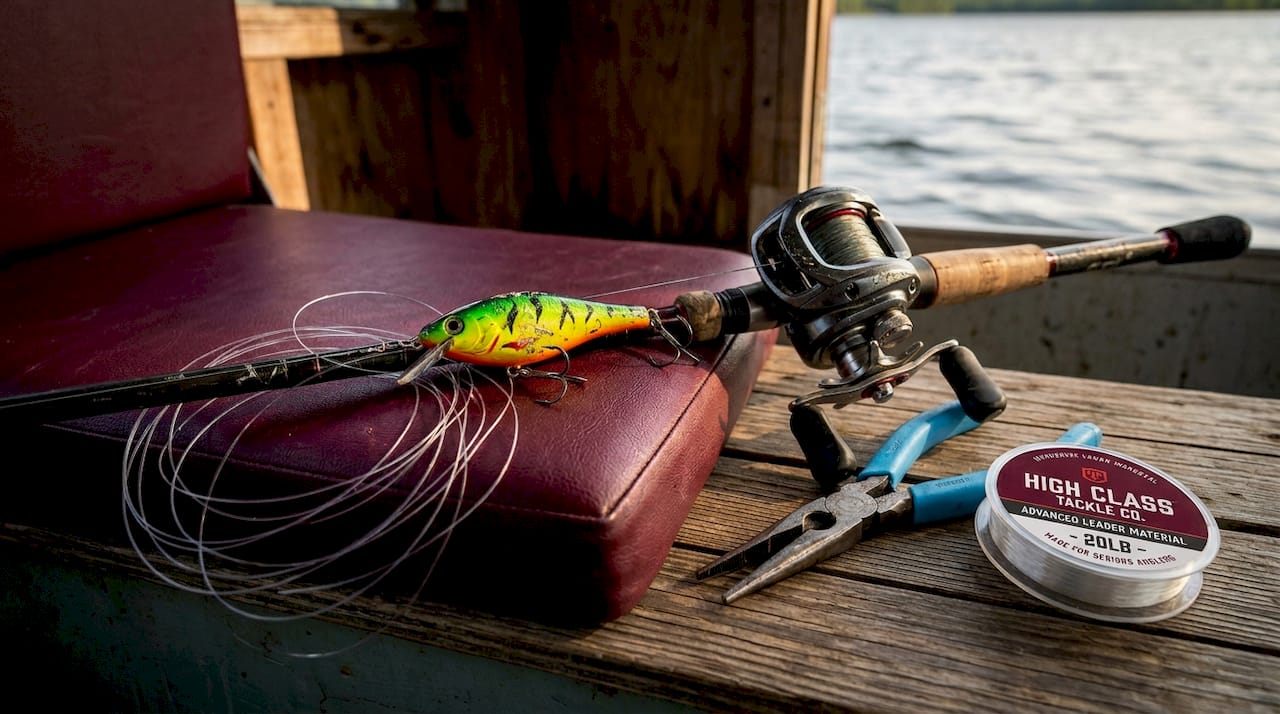
For bank anglers, you can get away with a shorter rod in the 8 to 9 ft range paired with a compact baitcaster or spinning reel. The goal is still a sensitive tip that telegraphs plug action and bites.
Best plugs for PNW river salmon
The top plug choices for Pacific Northwest river salmon are Kwikfish (K13 to K16), Mag Lips, Brad’s KillerFish, FlatFish, and Lyman plugs. Each has its own action profile. Kwikfish and Mag Lips produce a wide, erratic wobble that triggers aggressive strikes. Brad’s runs a tighter action that works well in slower water. FlatFish are a classic that still produce when other plugs go cold.
Here’s a quick comparison of the most popular plug options:
| Plug | Best water type | Action style | Common sizes |
|---|---|---|---|
| Kwikfish | Fast to moderate current | Wide, erratic wobble | K13, K14, K15, K16 |
| Mag Lips | Moderate to fast current | Deep, rolling action | 3.5, 4.5 |
| Brad’s KillerFish | Slow to moderate current | Tight, consistent wobble | 3.5, 4.5 |
| FlatFish | Slow to moderate current | Wide, side-to-side roll | T50, T55, U20 |
| Lyman | Moderate current | Aggressive wobble | Various |
Key gear checklist
- 9 to 10.5 ft medium-heavy rod with sensitive tip
- Line counter or baitcaster reel with smooth drag
- 40 to 65 lb braid or mono mainline
- 30 to 40 lb fluorocarbon leader, 3 to 6 ft
- Assortment of Kwikfish, Mag Lips, and Brad’s plugs
- Split rings for attaching and swapping hooks quickly
- Bait wrap materials: tuna, shrimp, or sardine
- Sharp quality treble hooks to replace factory hardware
Pro Tip: Factory treble hooks on most plugs are mediocre at best. Swap them out before your first cast. Sharp, reliable hooks are the difference between a solid hookup and a fish that shakes loose at the net. Pairing your plug with hoochie squid skirts can also add color and movement that triggers neutral fish.
Step-by-step: Backtrolling plugs from a boat
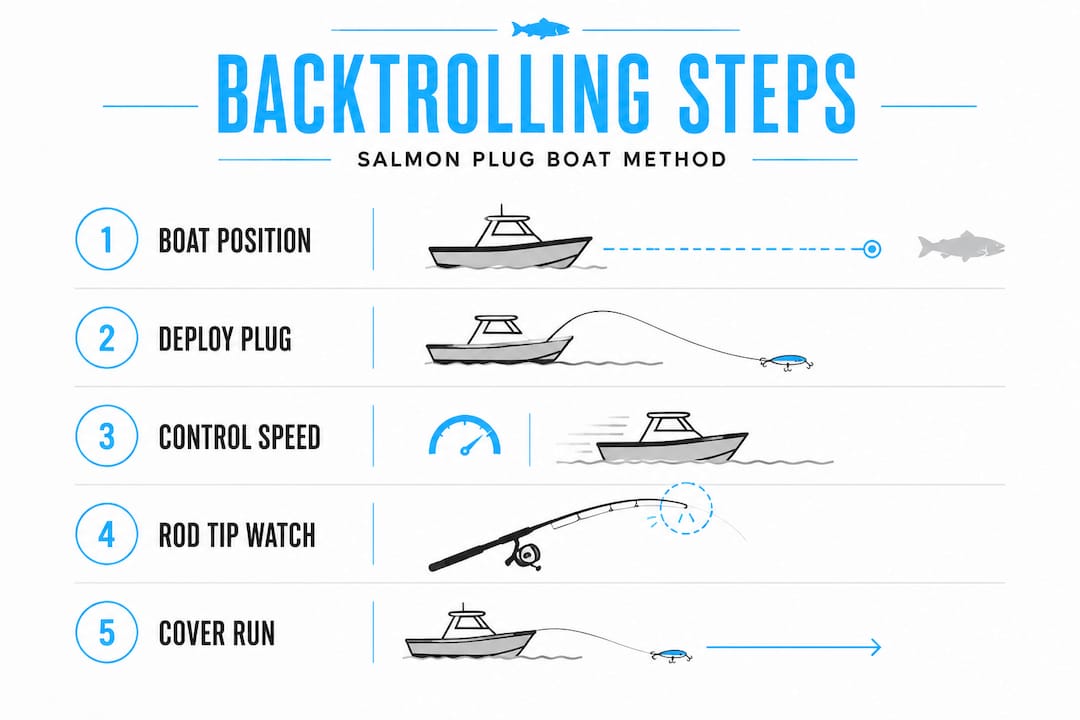
With gear dialed in, you’re ready to master the main boat tactic used in PNW salmon plug fishing. Backtrolling covers more water on larger PNW rivers like the Columbia and is ideal for anglers who want efficiency and depth control. Here’s how to execute it properly.
1. Position your boat above the target zone
Find a run, slot, or seam where salmon are likely holding. Position your boat upstream of the target, facing into the current. You want to control your downstream drift, not fight it.
2. Deploy your plugs to the right depth
Let your plugs out until they reach the strike zone. Key techniques include backtrolling slowly downstream, positioning plugs 6 inches to 3 feet off the bottom in 5 to 15 ft of water, and using your rod tip to gauge depth. If your tip is barely pulsing, you’re too shallow or too far back. If it’s loading up hard and dragging, you’re on the bottom.
3. Control your boat speed
Use your motor to slow your downstream drift. You want to move slightly slower than the current so your plugs maintain their action. Too fast and they spin out. Too slow and they lose their wobble.
4. Read your rod tip constantly
Your rod tip is your sonar. A steady, rhythmic pulse means your plug is working perfectly. A sudden stop or heavy load usually means a snag or a fish. Hesitate for a second, then set the hook firmly if it feels like a bite.
5. Work the full run before repositioning
Cover the water systematically. Work across the run from shallow to deep, adjusting line length and boat position as you go. Once you’ve covered the zone, motor back upstream and repeat.
6. React to bites without hesitation
When a salmon hits a plug, it often hooks itself on the initial strike. Keep steady pressure and don’t let the fish shake its head freely. Maintain tension throughout the fight.
Here’s how backtrolling compares to plunking from the bank:
| Method | Water coverage | Depth control | Accessibility | Best for |
|---|---|---|---|---|
| Backtrolling | Excellent | Precise | Requires boat | Boat anglers, large rivers |
| Plunking | Limited | Moderate | Bank access | Shore anglers, community spots |
“Backtrolling lets you cover a massive amount of productive water in a single drift. It’s the most efficient way to find active fish on big PNW rivers.”
Pro Tip: When running multiple rods, keep all your plug lengths identical. This is sometimes called the “wall of death” setup. Uniform depth means your plugs sweep through the strike zone together, creating a wall of action that salmon can’t ignore. Inconsistent lengths create tangles and dead zones. Use reliable treble hooks on every rod so you’re not giving up hookups when the bite turns on.
Safety note: Always follow river navigation rules. Keep an eye on boat traffic, respect other anglers’ water, and know your river before you run it in low light or high water conditions.
Bank fishing with plugs: Plunking technique and tips
Not everyone owns a boat. Here’s how bank anglers can catch just as many river salmon with the plunking technique.
Plunking is stationary plug fishing from the bank. You cast your rig out, let it settle, and let the current work your plug while you hold your position. It’s a proven method on community access spots along the Cowlitz and Columbia, and it’s a great way to connect with other anglers while you wait for a screaming run.
Core plunking setup
- Plug of choice (Brad’s KillerFish and Kwikfish are top picks)
- 18 to 24 inch leader between your mainline and plug
- Sliding sinker or float to keep the plug in the strike zone
- Scent or bait wrap: tuna, shrimp, or sardine packed tight
- Heavy mainline, 40 lb minimum, to handle current and big fish
Choosing your spot
Look for current seams, eddies behind large rocks, and slow water adjacent to fast water. Salmon use these transition zones to rest and stage. Community access areas on the Cowlitz and Columbia often have established plunking spots that experienced anglers have fished for years. Pay attention to where the locals set up.
“Plunking suits bank access and community spots on the Cowlitz and Columbia. Add scent for picky fish in clear water to dramatically increase your odds.”
Pro Tip: Scent is a genuine game-changer in clear water and on pressured fish. When salmon have seen every color and size of plug in the river, a fresh bait wrap can be the trigger that gets a reaction. Tuna and shrimp are the two most effective options. Change your wrap every 30 to 45 minutes to keep the scent trail fresh. Consider adding squid skirts to your rig for added visual attraction, or experiment with scents and wraps that match local forage.
Community etiquette on the bank
Give other anglers adequate space. On crowded community spots, that means at minimum 20 to 30 feet between setups. Don’t cast over someone else’s line. If you’re new to a spot, watch how the regulars are fishing before you set up. Respect river access rules, pack out your trash, and treat every angler you meet like a potential mentor. The PNW fishing community is tight-knit, and your reputation on the river matters.
River ethics and regulations every plug angler should know
Plugging may be effective, but sustainable salmon fishing depends on following rules and river ethics. This isn’t optional. It’s the foundation of keeping these fisheries productive for everyone.
Key regulations to know
PNW regulations are often mark-selective, meaning you can only retain hatchery salmon and steelhead with a clipped adipose fin. Bag limits are typically two salmonids per day with at least one Chinook required. These rules exist to protect wild salmon populations while still allowing harvest of hatchery fish.
- Adipose fin check: Only keep fish with a clipped adipose fin unless regulations specifically allow wild retention
- Bag limits: Usually two salmonids per day; always verify current season rules before you fish
- Size and species rules: Check for minimum size requirements and species-specific restrictions
- License and endorsements: Make sure your license and any required salmon endorsements are current
- River-specific closures: Some sections close seasonally or during low-flow events; check before you go
Ethical practices on the water
PNW fishing culture emphasizes conservation: release wild fish carefully, check water temperatures, and practice ethical angling during heat events.
Water temperature is critical. Avoid fishing when temps exceed 68°F because that’s the upper stress threshold for safe salmon release. Fish caught and released in water above 68°F face dramatically higher mortality rates. During heat waves, shift your fishing to early morning when temps are lowest, or take a day off entirely.
“Conservation isn’t just a rule. It’s the culture. The anglers who protect these rivers are the ones who get to fish them for decades.”
When you do release a wild fish, keep it in the water as much as possible. Support its body horizontally, face it into the current, and let it swim away on its own terms. A fish that swims off strong is a fish that might make it to the spawning grounds.
What most plug guides miss: Community, culture, and learning from failure
Most plug fishing guides are pure “how to.” They cover gear, technique, and regulations. What they rarely talk about is why you’re out there in the first place, and what actually makes you better over time.
The truth is, the anglers who become genuinely deadly with plugs aren’t the ones who read every article. They’re the ones who show up to the river consistently, blow bites, lose fish, and come back the next day with a new idea. Failure is the real teacher. Every missed hookup tells you something. Maybe your plug wasn’t deep enough. Maybe you hesitated on the set. Maybe the fish were holding tighter to structure than you thought. The anglers who pay attention to those moments and adjust are the ones who figure it out.
We’ve seen it happen in our own community. The guy who shows up to a community plunking spot and watches the regulars for an hour before setting up. The boat angler who asks questions at the launch instead of pretending to know everything. These people level up fast because they’re learning from real experience, not just theory.
The river culture in the PNW is something worth protecting. It’s built on shared knowledge, mutual respect, and a genuine love for these fisheries. The best plug anglers we know are also the most vocal about conservation. They understand that protecting wild salmon runs and following regulations isn’t a sacrifice. It’s an investment in the future of the sport they love.
There’s also something to be said for the social side of plug fishing. Some of the best tips we’ve ever gotten came from a stranger at a boat launch or a guy plunking two spots down the bank. Be open to those conversations. Share what’s working. That’s how the culture grows.
Up your salmon plug game with trusted tools and local flair
Ready to put these tactics and values into practice? Start with the gear that won’t let you down when a big Chinook slams your plug in heavy current.
High Class Tackle Co. has you covered from hooks to apparel. Upgrade your plug rigs with tournament-grade treble hooks that stay sharp through multiple fish and hard use. Rep your river lifestyle with the BOATS AND COHOS Tee, built for anglers who live this culture every day. Whether you’re backtrolling the Columbia or plunking the Cowlitz, our gear is built for real conditions by anglers who fish the same water you do. Check out the full tackle selection and build your kit for the season ahead.
Frequently asked questions
What’s the best plug size for PNW river salmon?
For most major Pacific Northwest rivers, use plugs in the K13 to K16 size range for consistent salmon action. Larger sizes like the K15 and K16 work especially well for big Chinook in heavy current.
How do I know if my plug is at the right depth?
Watch your rod tip. A steady pulsating rod tip means your plug is working correctly and near the bottom. Adjust line length up or down until you find that consistent rhythm.
Is scent necessary for bank fishing with plugs?
In clear, pressured water, adding scent or a bait wrap such as tuna or shrimp can significantly increase bites. Scent for picky fish in clear water is one of the most effective adjustments a bank angler can make.
What are the legal limits for keeping river salmon in the PNW?
Often, only hatchery salmon with a clipped adipose fin are legal to keep. Bag limits are typically two salmonids per day with at least one Chinook required, but always verify current season-specific rules before you fish.
Can I fish for salmon during heat waves?
It is best to avoid fishing when river temps exceed 68°F to reduce stress and mortality in salmon populations. Shift to early morning sessions or take a day off when temperatures spike.
0 comments