

The best starting point is a dry 3-2-1 cure, three parts borax, two parts sugar, one part non-iodized salt, packed over freshly butterflied skeins. Give it 24 to 48 hours refrigerated for a firm, bank-ready bait, or push closer to 72 hours in warmer water. Wear nitrile gloves and cure in a ventilated space, borax dust is nothing to breathe in casually.
TL;DR:
- Adjust curing ratios based on water temperature and current speed to avoid mushy bait in cold water or eggs that bounce off hooks in warm water.
- Refrain from adding scent powders or dyes at the start of the cure; only introduce them late to prevent interfering with egg firmness.
- Properly cure eggs with consistent turning and enough refrigeration time, typically between 24 and 72 hours, depending on skein thickness.
- Use the egg loop knot correctly and avoid over-tightening, especially with fluorocarbon, to prevent eggs from slipping off during fishing.
- Store cured eggs in airtight containers like mason jars to maintain freshness and reapply leftover cure liquid for added scent and color.
Table of Contents
- Best Salmon Egg Cure Recipes for Bank-Ready Bait
- How Do You Cure Salmon Roe Step by Step?
- How Does Water Temperature Change Curing Time?
- How Do You Tie the Egg Loop Knot?
- Why Are My Cured Eggs Mushy or Too Hard?
- How Long Do Cured Salmon Eggs Last in Storage?
- Handling Cure Chemicals Safely
- Ethical and Environmental Considerations for Bait Harvesting
- Author’s Field Notes and Proof Points from High Class Tackle Co.
- Skip the Mixing Bowl With Pro-Cure Ready-Made Options
- The Truth About “Perfect” Cure Ratios
- Sources
Best Salmon Egg Cure Recipes for Bank-Ready Bait
You don’t need a chemistry degree to cure eggs that hold up all day on the drift. You need a reliable ratio and the discipline to stick with it batch after batch. The 3-2-1 style dry cure, three parts borax, two parts sugar, one part non-iodized salt, is the workhorse recipe most West Coast anglers reach for first.
- 3-2-1 dry cure: 3 cups borax, 2 cups sugar, 1 cup non-iodized salt. Produces firm, durable eggs that survive repeated casts.
- Borax-heavy variant: Bump the ratio to 4-2-1 for skeins headed into fast, high-current water. More borax means tougher membranes and better mold resistance.
- Wet brine quick-cure: Dissolve 1 cup salt and ½ cup sugar into 2 cups warm water, then submerge skeins for 6 to 12 hours. Scent releases faster because the eggs are fully bathed instead of coated.
Add scent powders or dye late in the cure window, not at the start. Dumping shrimp or krill powder in too early interferes with the osmotic exchange that firms the egg in the first place. Kool-Aid packets work fine as a colorant if you want brighter roe for stained water.
How Do You Cure Salmon Roe Step by Step?
Curing salmon eggs is really about controlling moisture, not just dumping powder on skeins and hoping. Follow the sequence and you’ll get consistent bait every single time.
- Butterfly the skein. Slice down the membrane and gently peel it open, then rinse away any blood clots. Blood left on the egg mass causes off colors and faster spoilage.
- Apply the cure. For dry recipes, pack the mixture directly onto both sides of the skein and press it in. For wet brine, fully submerge the skein in the solution.
- Tumble or turn every few hours. This spreads the cure evenly and keeps one side from over-curing while the other stays raw.
- Refrigerate for the full window. Most anglers land in the 24 to 72 hour range, depending on skein thickness and desired firmness.
- Save the juice. Don’t pour it out. That liquid carries scent and color you can reuse on a later batch or drizzle back onto beads and yarn.
- Rinse lightly and pat dry. A quick rinse removes surface grit without stripping the cure that’s already absorbed into the egg.
- Test readiness. Squeeze a single egg between two fingers. It should hold shape and resist a slight pop, not squish flat.
Cut skeins into hook-sized clusters once they’re dry, sized to match your presentation.
How Does Water Temperature Change Curing Time?
Temperature changes everything about how a cure behaves, and ignoring it is how anglers end up with either soup or chalk. The chemistry behind curing hinges on an osmotic exchange, juice moves out of the egg first, then preservatives move back in, and that exchange speeds up or slows down with temperature.
- Cold water (below 40°F): Borax dissolves poorly in cold conditions, so pre-dissolve it in warm water for wet brines, or lean on sugar and a light sulfite mix instead.
- Warm water (above 55°F) or high current: Increase borax slightly for structure and mold resistance, since warmth accelerates bacterial growth.
- Baseline reabsorption: Most cures finish their core chemical work in 12 to 24 hours, even if you refrigerate longer for extra firmness.
Pro Tip: If your eggs feel slick and slippery after 24 hours, they’re not done. Ready eggs feel slightly tacky, almost like the surface of a gumdrop.
How Do You Tie the Egg Loop Knot?
A perfectly cured egg means nothing if it flies off the hook on your first cast. The egg loop knot exists specifically to solve that problem, and it retains roughly 85 to 90 percent of your line’s original strength when tied correctly.
- Thread your line through the hook eye twice, leaving a loop hanging below the shank.
- Wrap the tag end around the shank six to ten times, working down toward the bend.
- Pass the tag end back through the eye and cinch it down slowly.
- Wet the knot before the final pull, dry mono can weaken under friction.
- Slide your egg cluster into the loop and snug it against the shank.
Mono in the 10 to 20 pound range ties the cleanest loops. Fluorocarbon works too, but warm it between your fingers first or it fights you on the wraps. Snelled hooks and bait mesh are solid backups when you’re running clusters too small for a clean loop. Check hook and shank length choices if your egg loops keep slipping, the wrong shank length is often the real culprit.
Pro Tip: Give the loop a firm tug before you clip your leader. If it slides, retie it, don’t trust a loose loop on a drift with any current.
Why Are My Cured Eggs Mushy or Too Hard?
Every angler ends up with a bad batch eventually. Here’s how to fix the most common failures fast.
- Mushy eggs: Usually caused by too much acid, sulfite, or excess brine time. Re-dry in fresh borax for a few hours or run a short second cure.
- Soupy consistency: Drain excess liquid rather than adding more cure powder, then let the batch sit uncovered in the fridge for an hour to firm up.
- Chalky or too firm: Cut back on borax next time, or briefly re-soften in a light wet brine for 20 to 30 minutes.
- Color or scent overload: Dye and scent oils are easy to overdo. A light dusting goes further than a heavy pour, and fish can be turned off by overpowering scent just as easily as they’re drawn in.
How Long Do Cured Salmon Eggs Last in Storage?
Proper storage is what separates a bait that performs in June from one you’re tossing in July. Airtight containers matter more than most anglers realize.
- Jars beat bags for longevity. Mason jars with minimal headspace and a vacuum seal keep eggs firmer longer than a zip bag full of trapped air.
- Refrigerator timeline: Cured eggs typically hold for several weeks in the fridge before quality drops.
- Freezer timeline: Properly cured and packed eggs can last close to a year frozen, thaw them slowly in the fridge rather than on the counter.
- Reuse the juice. Leftover cure liquid still carries scent and color, use it to re-coat beads, yarn, or a future batch of eggs.
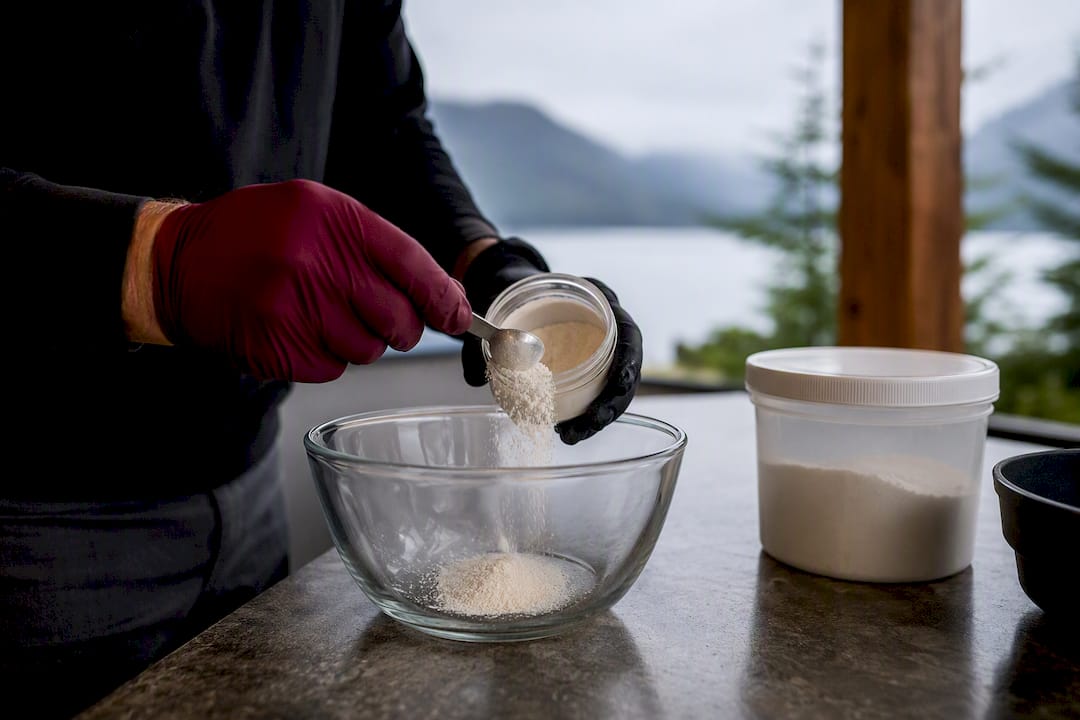
Handling Cure Chemicals Safely
Borax and sulfite-based cures aren’t dangerous when handled with basic precautions, but skipping them is a bad habit. Wear nitrile gloves and a dust mask if you’re measuring powder in a closed space, and mix cures somewhere with airflow. Sulfites in particular deserve caution, fishery health guidance warns against overuse since concentrated sulfite exposure can stress fish and aquatic life. Never dump leftover cure liquid into a river, ditch, or storm drain, bag it and toss it with household trash instead.
Ethical and Environmental Considerations for Bait Harvesting
Curing your own eggs starts with sourcing them responsibly, and that part matters just as much as the ratio in your mixing bowl. Only harvest skeins from fish you’re legally allowed to keep under your state’s regulations, and check season-specific rules before you fillet, some rivers restrict roe retention even when the fish itself is legal to keep. Wasting a skein because you over-processed it or let it spoil defeats the purpose of harvesting it in the first place, treat every egg mass with the same respect you’d give the meat.
Selecting quality skeins starts at the cleaning table. Fresh, bright orange or red skeins with tight egg membranes cure far better than ones that sat too long on ice or got crushed during handling. Bruised or broken skeins release blood and oils that spoil faster and cure unevenly, so keep your knife work clean and separate roe from other fish parts immediately.
There’s also a resourcefulness angle here worth mentioning. Anglers who cure their own eggs are, by definition, using more of the fish they catch instead of discarding roe as waste. That’s a small but real form of respect for the resource, especially on rivers where salmon runs face pressure from habitat loss and changing water conditions. Curing eggs at home, rather than buying commercially packaged roe of unknown origin, also keeps your bait sourcing tied directly to fish you caught yourself under your own license and season limits.
Author’s Field Notes and Proof Points from High Class Tackle Co.
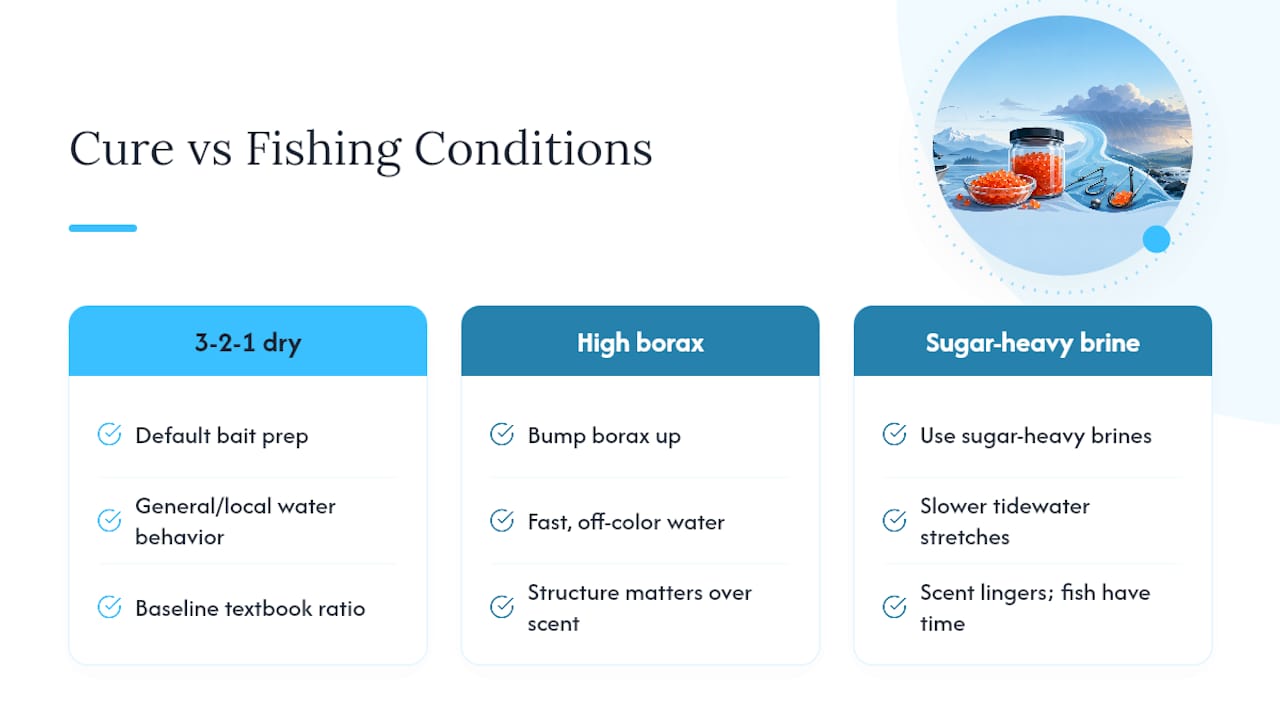
I lean on the 3-2-1 dry cure for most of my own bait prep, but I’ll bump borax up whenever I’m fishing fast, off-color water where structure matters more than scent. Sugar-heavy brines get more use on slower tidewater stretches where fish have time to sit on the smell before committing. Every angler eventually drifts from the textbook ratio once they learn how their local water behaves, and that’s exactly how it should go.
High Class Tackle Co. has covered plenty of related ground on the blog, including bait presentation strategies that pair naturally with a good cure. If you’re chasing shrimp-based baits alongside your egg program, the shrimp curing breakdown applies a lot of the same chemistry.
Editor’s note: Nick’s full angling credentials and any relevant client testimonials will be added here.
Skip the Mixing Bowl With Pro-Cure Ready-Made Options
If you’d rather skip the measuring cups altogether, Highclasstackleco carries Pro-Cure additives built for anglers who want lab-consistent chemistry without mixing borax and sugar in the garage every week.

The Pro-Cure Ultimate Egg Cure is a ready-to-use cure that handles the ratio work for you, just pack it onto a butterflied skein the same way you would a homemade dry mix, and let it sit through the same 24 to 72 hour window. It’s a solid pick for anglers who fish often enough that consistency matters more than customizing every batch by hand. This isn’t a replacement for learning the craft, it’s a convenience option for days when you need reliable bait fast and don’t want to second-guess your ratios. Browse the full Pro-Cure lineup and grab a bottle before your next trip to the river.
The Truth About “Perfect” Cure Ratios
Most cure guides treat the 3-2-1 ratio like scripture, and that’s a mistake. The recipe is a starting point, not a rulebook. Water temperature, current speed, skein thickness, and even how long your eggs sat on ice before you started all push the ideal ratio in different directions. An angler fishing a cold tailwater in December needs a different mix than someone working a warm, slow-moving tributary in August, and treating both situations the same way is how you end up with mushy bait or eggs so hard they bounce off a hook.
What actually separates anglers who consistently cure great bait from those who don’t isn’t a secret recipe. It’s a willingness to adjust based on what the eggs are telling them, texture, smell, how the juice looks after the first few hours, rather than following a printed ratio to the letter every single time. The chemistry matters, but so does paying attention.
— Nick
Sources
- Knots
- How to Cure Salmon Eggs with Borax, Sugar & Salt (3-2-1 Recipes) - BC Fishing Journal
- Osmosis & pH: The Biochemistry of Curing Salmon Eggs
0 comments