

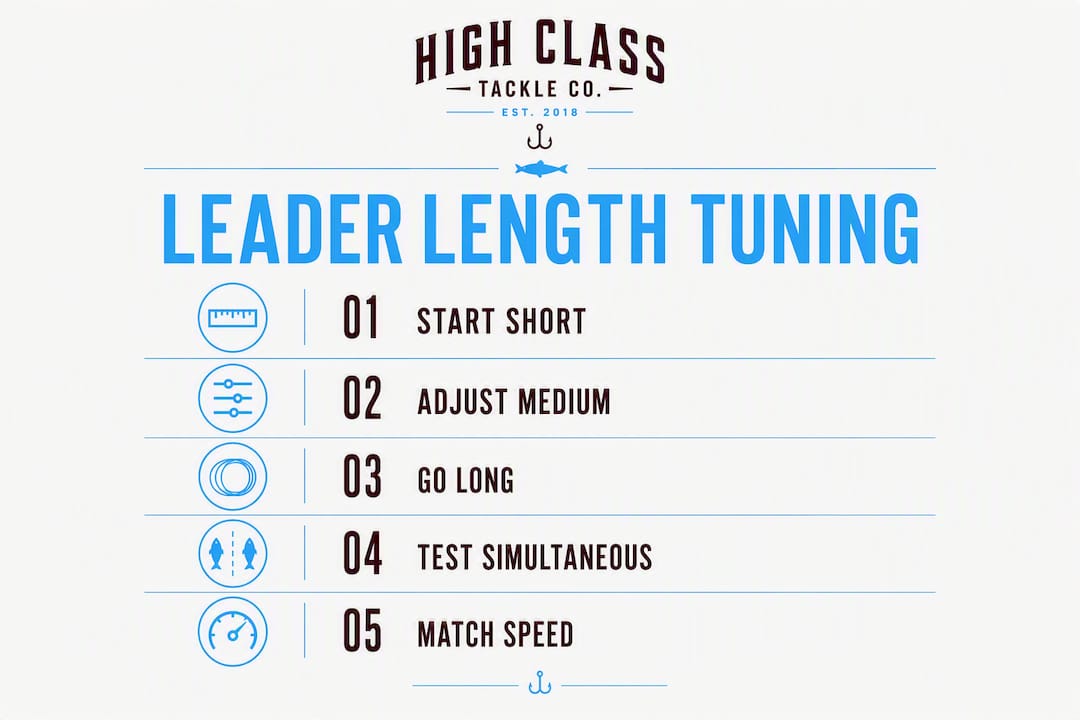
Start with a short leader behind the dodger as your baseline. If kokanee are following but not committing, lengthen by 2–3 inches and run it again. Most bites happen somewhere in the short-to-medium leader range, and the difference between a dead rod and a screaming reel often comes down to fine leader length adjustments. For lures with their own side-to-side action, like spoons and small plugs, use a longer leader to ensure the dodger’s kick doesn’t interfere with the lure’s natural movement. Here’s your immediate on-water checklist from Highclasstackleco:
- Set your baseline leader at 8–12 inches for hoochies and non-action lures
- Run a control rod at 1.0–1.2 mph, which California DFW confirms is the sweet spot for most dodger setups
- Change leader length in 2–3 inch steps before touching anything else
- Log each change — rod, leader length, speed, and result
- Present your lure 3–5 feet above the school, not straight through it
- Use the Rule of 100 (depth in feet + setback in feet ≈ 100) to plan your setback and avoid spooking fish, a method Idaho Fish and Game recommends for clear-water trolling
Table of Contents
- Why leader length controls what your lure actually does
- Short vs. long leaders: which range fits your lure?
- What to do when kokanee follow but won’t bite
- How to rig your dodger and measure leader length on the water
- How trolling speed and depth work with your leader setup
- Field-tested tuning tips that actually change results
- Common spacing mistakes that cost you strikes
- Key Takeaways
- The part most anglers skip
- Gear up with Highclasstackleco for your next kokanee session
- Useful sources and further reading
Why leader length controls what your lure actually does
The dodger doesn’t just attract fish. It drives your lure. Every side-to-side kick the dodger makes sends a pulse of energy down the leader and into whatever is tied at the end. Leader length controls how much of that energy arrives, and in what form.
A short leader, say 8–10 inches, transmits the dodger’s full snap directly to the lure. The result is an aggressive, erratic action that triggers reaction strikes from actively feeding fish. A long leader, 14–16 inches or more, absorbs some of that snap. The lure moves more smoothly, more naturally, which tends to draw feeding strikes from fish that are suspicious or pressured.
The distance between your dodger and your lure is the most critical variable in your setup. Get that wrong, and nothing else you do will fix it.
That’s why you dial leader length before you swap lures. The lure might be perfect. The leader might just be off by three inches.
Depth presentation matters just as much as action. Kokanee feed upward, so you want your lure sitting 3–5 feet above the school, not running through the middle of it. Trolling at the right depth but with a leader that’s killing your lure’s action is a common reason fish follow and then peel off without biting.
Pro Tip: When you mark fish on the sonar, note the depth and set your downrigger to put the lure 3–5 feet shallower. Then focus your leader adjustments from there.
Short vs. long leaders: which range fits your lure?
The right leader length depends almost entirely on what you’re running behind the dodger. Here’s how to match the range to the lure.
Short leaders (8–12 inches)
Use this range when your lure has no independent action of its own. Hoochies, wedding ring spinners, and Spin-N-Glos need the dodger’s kick to give them life. A short leader keeps that energy transfer tight and aggressive. This range also works best when fish are actively feeding and want a fast, erratic presentation.
Medium leaders (12–16 inches)
Step up to this range when fish are following but not biting, or when the bite has slowed mid-session. The slightly longer leader softens the action just enough to make the lure look less frantic. Spinners often perform well in this range too, where they get some dodger influence but still have room to spin.
Long leaders (20–30 inches)
Spoons, small plugs, and any lure with its own side-to-side wobble need distance from the dodger. Running a spoon on a 10-inch leader kills its action entirely. Give it 20–30 inches and it works the way it was designed to.
A quick conversion method: multiply your dodger length by 2.5–3.5 for non-action lures early in the season, and shorten to 2–2.5 times the dodger length in summer when fish are more active. For lures with independent action, run 4–5.5 times the dodger length.
| Lure Type | Leader Range | Notes |
|---|---|---|
| Hoochies | 8–12 inches | Needs dodger kick for all action |
| Wedding ring spinners | 8–14 inches | Short keeps the spin tight |
| Spinners (independent) | 14–20 inches | Room to spin without dodger interference |
| Spoons / small plugs | 20–30 inches | Dodger for attraction only; lure drives the action |
| Gang troll setups | 24–30 inches | Standard range behind lake troll flashers |
What to do when kokanee follow but won’t bite
This is the most frustrating situation in kokanee trolling, and it has a repeatable fix. The key is changing one thing at a time. Change two variables at once and you’ll never know what actually worked.
Follow this sequence in order:
- Shorten or lengthen the leader by 2–3 inches. This is almost always the first move. If you’re at 10 inches, try 12. If you’re at 14, try 11. Small adjustments frequently convert follows into bites without any other change.
- Adjust speed by ±0.1–0.3 mph. If leader changes don’t produce a bite after two or three passes, nudge your speed. Slower speed increases dodger kick; faster speed flattens it.
- Change lure action or type. If leader and speed adjustments haven’t worked, swap to a different lure profile. Try a hoochie if you were running a spoon, or vice versa.
- Add or change scent and bait. Tip your hook with white shoepeg corn, maggots, or shrimp. Add a scent like tuna oil, garlic, or anise. The ODFW recommends these as standard kokanee attractants, and they can be the difference on pressured fish.
- Log every change. Write down rod number, leader length, speed, lure, and result. Patterns emerge fast when you track them.
The fastest way to find a productive leader length is to run staggered rigs simultaneously. Put one rod at 8 inches, one at 12, one at 16. Whichever rod fires first tells you where to set the rest.
| Adjustment Step | What to Change | Range |
|---|---|---|
| 1 | Leader length | ±2–3 inches |
| 2 | Trolling speed | ±0.1–0.3 mph |
| 3 | Lure type or action profile | Hoochie ↔ spoon ↔ spinner |
| 4 | Bait tip and scent | Corn, maggots, shrimp, tuna oil |
How to rig your dodger and measure leader length on the water
Rigging a dodger correctly is fast once you know the setup. Here’s how to do it right.
Attachment points matter. Most dodgers have multiple holes at the top. The hole you use changes the angle and swing of the dodger. The outermost hole creates the widest kick; moving inward tightens the action. Start with the middle hole and adjust from there based on speed and desired action.
Measuring leader length afloat:
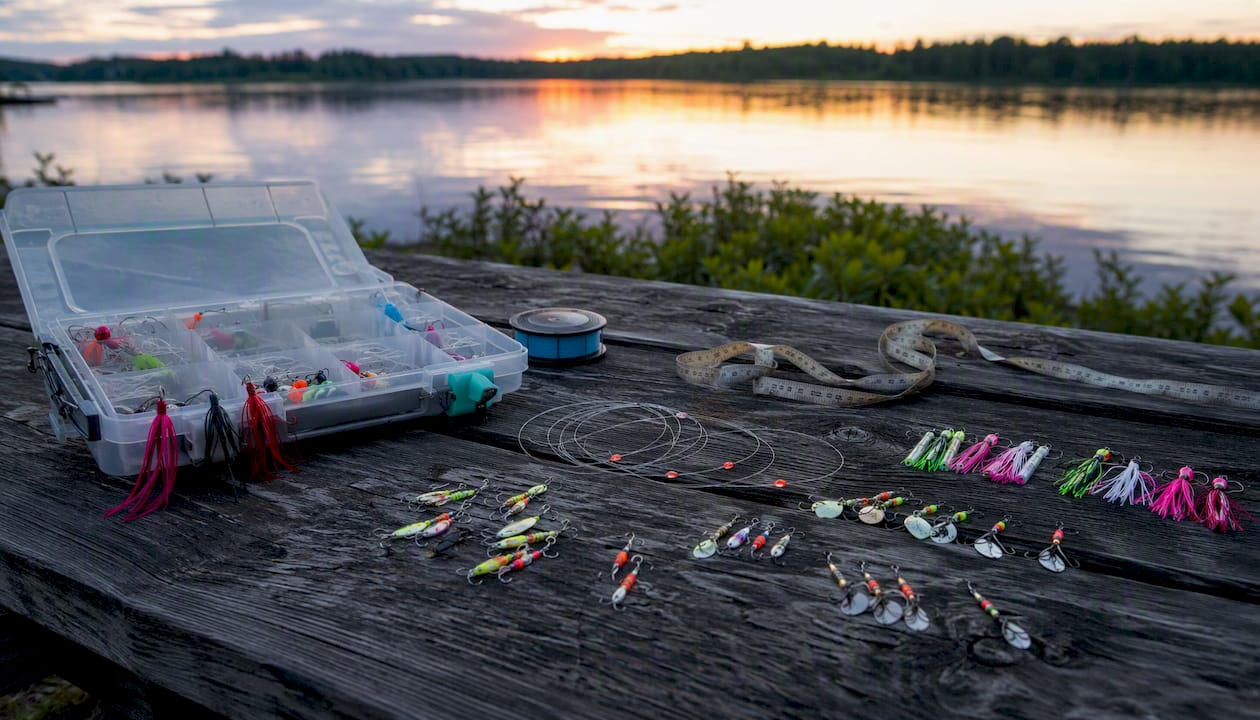
- Pre-cut leaders at home in 2–3 inch increments (8", 10", 12", 14", 16", 20", 24", 30") and label each with a permanent marker or color-coded tag.
- On the water, use your rod butt as a quick reference. Mark it with tape at 8, 12, and 16 inches from the tip guide so you can measure without a ruler.
- Attach the leader to the dodger’s bottom hole with a quality snap swivel. Tie the lure at the other end.
- Measure from the snap at the dodger’s bottom to the lure’s hook eye. That’s your leader length.
Leader material and strength:
- Use 10–15 lb monofilament for kokanee leaders. Kokanee are not particularly leader-shy, so you don’t need to go ultra-light.
- Mono has enough stretch to absorb the dodger’s snap without transmitting too much shock to the lure.
- Fluorocarbon works too, but mono is the standard and performs well across all leader lengths.
Pro Tip: Pre-cut your leaders the night before and store them in a small leader wallet organized by length. On the water, you can swap a leader in under a minute without fumbling with a tape measure.
How trolling speed and depth work with your leader setup
Trolling speed for kokanee runs 0.8–1.5 mph, with 1.0–1.2 mph as the practical starting point for most dodger setups. That range is where dodgers produce their best kick without going erratic or going flat.
Speed and leader length interact directly. Slow down below 1.0 mph and the dodger’s kick gets more aggressive. At that point, a long leader can cause the lure to swing too wildly. Shorten the leader to compensate. Speed up toward 1.5 mph and the dodger’s action flattens out. A longer leader gives the lure more freedom to move on its own, which can actually help at higher speeds.
Depth is the other half of the equation. Kokanee feed upward, so your lure needs to sit 3–5 feet above the school, not at the same depth. Use your sonar to mark the school, then set your downrigger accordingly. When trolling near the surface or in clear water, the Rule of 100 keeps you from spooking fish: downrigger depth (ft) + setback distance (ft) should equal roughly 100. At 30 feet deep, that means 70 feet of setback.
Pro Tip: If you’re marking fish but not getting bites, check your depth before you touch your leader. Running 5 feet too deep is just as deadly as running the wrong leader length.
Field-tested tuning tips that actually change results
Small adjustments beat big swaps. That’s the core lesson from guide-boat experience on PNW reservoirs. Here’s what actually moves the needle.
Bending your metal dodger is one of the most underused adjustments. A deeper bend creates a more aggressive snap at slow speeds (0.8–1.2 mph). A flatter bend suits higher-speed searches (1.5 mph and above). Bend gently with your hands, check the action boat-side before you drop it down, and adjust until the kick looks right for your current speed.
- Carry pre-cut leaders in 2–3 inch increments. You’ll swap them faster and test more combinations in a single session.
- Change leader length before you change lures. A 2–3 inch adjustment on the same lure often outperforms a full lure swap when fish are following.
- Test dodger attachment holes. Moving from the outer hole to a middle hole can tighten the kick enough to trigger bites without any other change.
- Run one “control” rod at your baseline setup while you experiment with others. If the control rod fires, you know the baseline is still working.
- Watch your dodger boat-side before every drop. If it’s not kicking cleanly, bend it or adjust your speed before you waste time trolling a dead rig.
The guides who consistently put fish in the net aren’t running exotic setups. They’re running dialed setups, and they got there by making small, deliberate changes and logging what worked.
Common spacing mistakes that cost you strikes
Most missed bites come down to a handful of fixable errors. Run through this list before you blame the fish.
- Leader too long for a non-action lure. A hoochie on a 20-inch leader behind a dodger gets almost no action. The dodger’s energy dissipates before it reaches the lure. Keep non-action lures at 8–12 inches.
- Leader too short for a spinner or spoon. A spoon on a 10-inch leader can’t wobble. You’re paying for the lure’s action and then killing it with your rigging.
- Changing two variables at once. Never swap the lure and change the leader length in the same pass. You’ll never know which change produced the bite or killed the bite.
- Ignoring trolling speed. Running at 1.8 mph with a dodger setup built for 1.0–1.2 mph produces flat, lifeless action. Check your speed before you adjust anything else.
- Not staggering rigs. Running all rods at the same leader length means you’re testing one setting per pass. Stagger them and you test three settings simultaneously.
- Skipping the log. Memory is unreliable on the water. Write down what’s working. The pattern you find today is the starting point for next trip.
Key Takeaways
Start 8–12 inches behind the dodger, adjust in 2–3 inch steps, troll at 1.0–1.2 mph, and present your lure 3–5 feet above the school — those four rules cover the majority of kokanee dodger spacing decisions on the water.
| Point | Details |
|---|---|
| Start short, adjust up | Begin at 8–12 inches; lengthen by 2–3 inches if fish follow but don’t bite. |
| Match leader to lure type | Non-action lures (hoochies) need 8–12"; spoons and plugs need 20–30" to work freely. |
| Speed baseline | Troll at 1.0–1.2 mph; adjust speed only after leader changes fail to produce bites. |
| Depth presentation | Set lure 3–5 feet above the marked school; use the Rule of 100 for setback planning. |
| Highclasstackleco gear | Pre-cut leader kits and terminal tackle from Highclasstackleco let you swap lengths fast and test more setups per session. |
The part most anglers skip
Here’s the honest take on kokanee dodger spacing: most anglers spend too much time chasing lure color and not enough time dialing leader length. Color gets all the attention because it’s visible and easy to swap. Leader length is invisible once the rig is in the water, so it gets ignored.
The guides who consistently put fish in the boat on PNW reservoirs, including the team at Highclasstackleco, have tested these exact leader ranges across multiple seasons and multiple bodies of water. The 8–12 inch baseline isn’t a guess. It’s the range where the dodger’s action transfers most effectively to the lure across the widest variety of conditions. The 2–3 inch adjustment rule exists because that’s the smallest change that produces a measurable difference in lure action.
What most anglers underestimate is how much the dodger itself changes the equation. A bent metal dodger at 1.0 mph behaves completely differently than the same dodger at 1.4 mph. Leader length that works perfectly at one speed can ruin the presentation at another. That’s why speed and leader length have to be tuned together, not independently.
Pre-cut leader kits solve the biggest practical problem: swapping leaders on the water without a ruler or a fumble. Highclasstackleco stocks terminal tackle and leader components specifically for this kind of dialing, because the anglers who catch the most fish are the ones who can test the most setups in a single session.
Gear up with Highclasstackleco for your next kokanee session
The fastest way to dial your dodger spacing is to have the right leaders ready before you leave the dock. Highclasstackleco carries terminal tackle and leader components built for exactly this kind of on-water testing, including hooks, snaps, and leader materials in the 10–15 lb monofilament range that kokanee setups demand.
Pair your leaders with Pro-Cure scent additives to tip your hooks with tuna oil, garlic, or shrimp scent alongside white shoepeg corn or maggots. Our kokanee scent and bait tips break down exactly which combinations produce the most bites when fish are pressured. We also carry blade packs and dodger-adjacent gear for anglers who want a complete starter kit without hunting down individual components. Browse the full lineup at Highclasstackleco and reach out to the team directly if you want guide-boat tuning tips for your specific reservoir.
Useful sources and further reading
These are the primary sources behind the numeric recommendations in this guide. Worth bookmarking if you want to dig deeper.
- California Department of Fish and Wildlife — Kokanee Fishing: Trolling speed guidance (0.8–1.5 mph baseline) and general kokanee presentation advice.
- Idaho Fish and Game — Kokanee Fishing Tips: Source for the Rule of 100 (depth + setback ≈ 100 ft) and setback planning in clear water.
- Oregon Department of Fish and Wildlife — Kokanee Fishing in Oregon: Leader material recommendations (10–15 lb mono) and bait/scent options (shoepeg corn, maggots, shrimp, tuna oil, garlic, anise).
- Kokanee Krew — Leader Length for Kokanee Salmon: Primary source for the 8–16 inch leader range and the 2–3 inch adjustment rule.
- BC Fish’n — Leader Lengths for Kokanee Fishing: Dodger-length multiplier formula (2.5–3.5× early season; 2–2.5× summer; 4–5.5× for action lures).
Recommended
- Kokanee Scent Bait Tips That Double Your Hookups – High Class Tackle Co.®
- Custom Spinner Blades for Salmon and Steelhead Success – High Class Tackle Co.®
- Spinnerbait guide: boost your Pacific Northwest fishing – High Class Tackle Co.®
- BC Sockeye Fishing Tackle Guide for PNW Anglers – High Class Tackle Co.®
0 comments