

Spinner-style blades, flashers, and beads work for salmon, steelhead, kokanee, and nearshore saltwater species — and they are one of the fastest ways to cover water and trigger aggressive strikes. Your starter combo: a size 4 Colorado blade in hammered silver, a translucent orange bead, and 12 lb fluorocarbon leader. Tie it on and go.
When to run this combo:
- Stained river water (2–6 ft visibility) in fall or early winter
- Overcast mornings when vibration outranks flash
- Any run where you need to cover water fast before conditions change
Quick shopping pointer: Highclasstackleco stocks blades, beads, and terminal components built for exactly these conditions — more on that below.
Pro Tip: Before your first cast, dip the rig and watch the blade spin. If it doesn’t kick within two turns of the reel, your retrieve speed or blade angle is off. Fix it at the bank, not mid-drift.
Key Takeaways
Spinner-style blades tuned to water clarity, blade shape, and bead translucency are the most adaptable multi-species tool a West Coast angler can carry.
| Point | Details |
|---|---|
| Water clarity drives blade choice | Willow for clear water, Colorado for muddy/low-light, tandem for stained conditions. |
| Bead translucency is a trigger | Translucent beads let light pass through and can outperform opaque jigs in clear or low water. |
| Slow down for steelhead | Cold-water presentations should keep the blade in the fish’s depth plane, not burning past it. |
| Minimal kit, maximum coverage | Three blade shapes in two finishes plus a bead assortment handles most daily condition changes. |
| Highclasstackleco | Stocks field-tested blades, beads, and terminal components for all three West Coast combos above. |
Table of Contents
- How spinner blades and beads trigger strikes in salmon and steelhead
- Choosing blade shapes, sizes, finishes, and bead colors by conditions
- Tackle setup: rods, reels, lines, and depth control
- Species-specific tactics for salmon, steelhead, kokanee, and saltwater
- Step-by-step rigging: beads, trailer hooks, knots, and hardware
- What anglers get wrong with spinner-style tackle
- Your West Coast tackle kit and three ready-to-fish combos
- Highclasstackleco has the gear to build every combo above
- A West Coast angler’s honest take on spinner-style rigs
- Sources
How spinner blades and beads trigger strikes in salmon and steelhead
Flash, vibration, and translucency hit three separate sensory systems at once. That multi-trigger combination is why spinner-style rigs outperform single-sense presentations in so many West Coast conditions.
The optical flash from a Willow leaf blade fires at distance in clear water. A Colorado blade sacrifices some flash for a wider wobble angle, pushing a pressure wave that salmonids detect through their lateral line — critical in murky or off-color flows. Beads add a third layer: translucency that lets light pass through, creating a glow effect that opaque jigs simply can’t replicate in low or clear water.
The lateral line never lies. In water with less than 2 ft of visibility, a fish may never see your blade — but it will feel the thump of a Colorado from several feet away. Vibration is your primary weapon in muddy conditions; flash is a bonus, not the lead.
- Willow leaf: maximum flash, minimal thump — clear water, faster retrieves
- Colorado: maximum thump, moderate flash — stained to muddy water, slow swings
- Indiana/tandem: balanced flash and vibration — the workhorse for mixed conditions
According to blade-type analysis from MasterFishingMag, a tandem small-Colorado plus medium-Willow configuration covers the majority of typical Western river situations and is a smart default for a minimal kit.
Choosing blade shapes, sizes, finishes, and bead colors by conditions
Match blade type to visibility first, then speed. That single rule eliminates most bad days on the water.
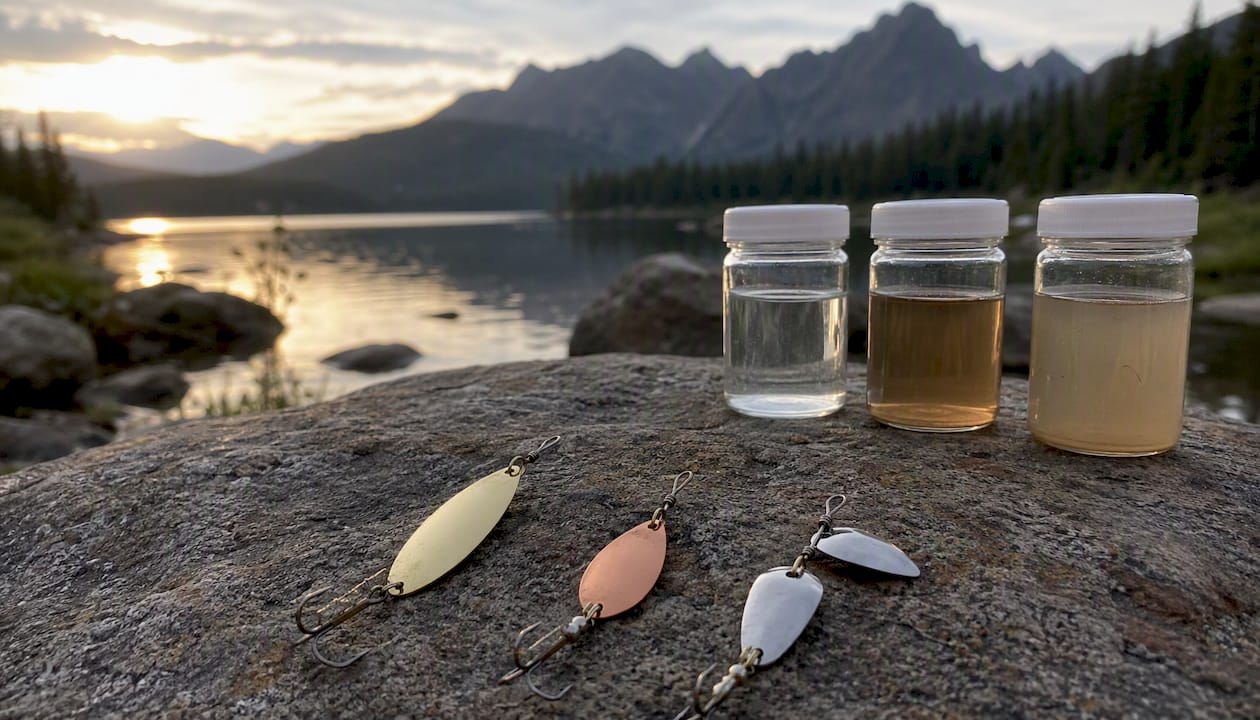
| Visibility | Blade Shape | Finish | Bead Type |
|---|---|---|---|
| Clear (>6 ft) | Willow leaf | Hammered silver or chrome | Translucent — peach, pink, or clear |
| Stained (2–6 ft) | Indiana or tandem | Gold or copper | Semi-translucent — orange, chartreuse |
| Muddy (<2 ft) | Colorado | Painted bright or UV | Opaque — red, hot pink, or white |
Outdoor Life’s bead-selection guidance is direct: “water clarity is always the biggest factor.” Start with chartreuse or orange in green-tinted flows, then adjust intensity based on sky and light. A single red “blood dot” on an otherwise natural bead can shift steelhead responses on pressured rivers — and what works one week may not work the next as conditions shift.
For finishes, silver reads cool and bright in clear water; gold warms up in off-color flows. Painted blades in UV or chartreuse are your muddy-water insurance policy.
Pro Tip: Carry three blade shapes in two finishes each, plus a bead assortment in translucent, semi-translucent, and opaque. That 12-piece kit handles a wide range of daily condition changes without a tackle box overhaul.
Tackle setup: rods, reels, lines, and depth control
Use a medium-heavy to heavy spinning rod (8.5–10.5 ft, moderate-fast action) for river swinging, or a 7–8.5 ft medium-heavy for casting and trolling. Centerpin setups shine for slow-swing steelhead presentations in deeper slots.
Line and leader basics:
- Mainline: 20–30 lb braid for sensitivity and zero stretch
- Leader: 10–17 lb fluorocarbon — abrasion-resistant and nearly invisible in clear water
- Mono: still works for kokanee and lighter saltwater applications where stretch absorbs shock
| Depth Method | When to Use | Weight/Setup |
|---|---|---|
| Inline weight | Casting rivers, moderate current | 0.25–1 oz pencil lead above swivel |
| Split shot | Light presentations, kokanee | 1–3 BB shot, 12 in above blade |
| Downrigger | Trolling for salmon, deep water | Standard ball, — |
| Planer board | Covering width on open water | Paired with inline weight |
For reels, a 3000–4000 size spinning reel with a smooth drag rated to at least 15 lb handles most river and nearshore work. Test sink rate before fishing: drop the rig in a known-depth pool and count seconds to bottom. Adjust weight until you’re ticking structure without snagging.
Species-specific tactics for salmon, steelhead, kokanee, and saltwater
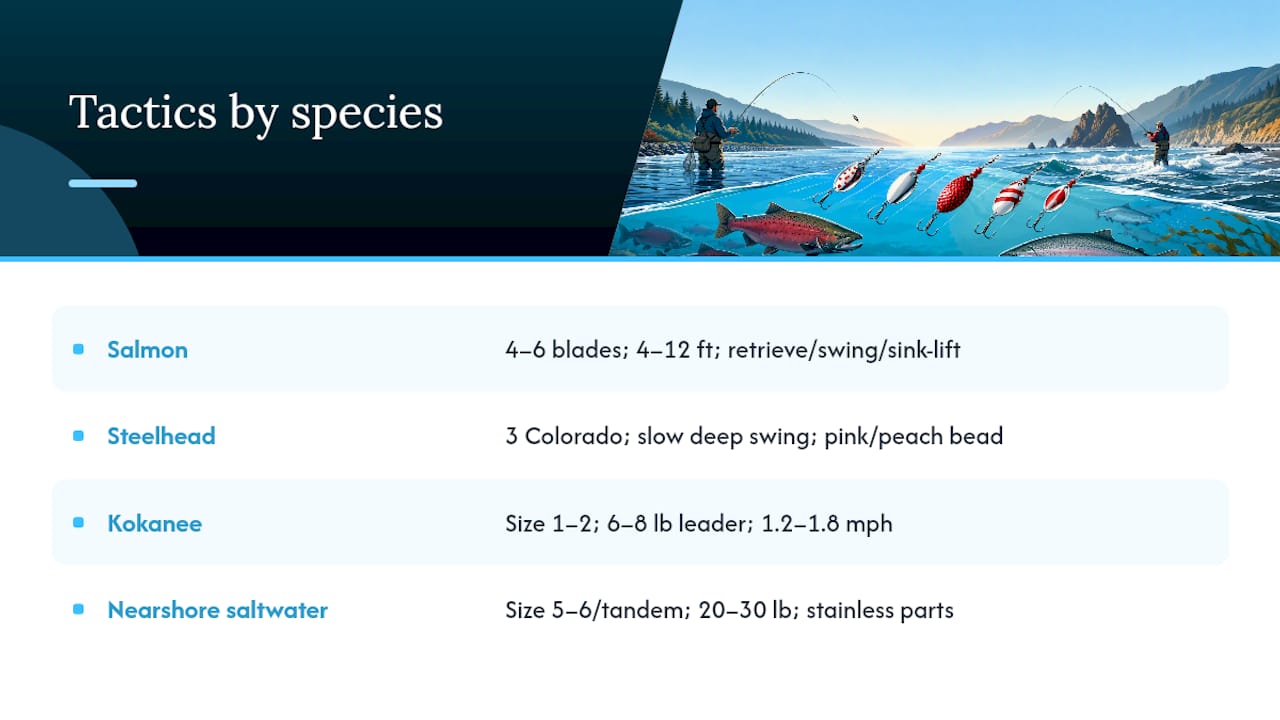
Salmon: Swing or troll with size 4–6 blades. Long, thin blades cut deeper in fast current; wider blades work better in shallower, slower flows. Three presentations that produce: steady retrieve, downstream swing, and sink-and-lift for holding fish. Target depth windows of 4–12 ft depending on river stage. Dawn and the hour before dark are prime.
Steelhead: Slow down. Cold water and low-current conditions call for a slow-and-deep swing that keeps the blade in the fish’s plane rather than burning past it. A size 3 Colorado with a translucent pink or peach bead is a proven winter combination. Bead color can shift daily — carry three finish options and rotate every 20 minutes without a strike.
Kokanee: Go light. Size 1–2 blades, 6–8 lb leader, and a small translucent bead in pink or red. Kokanee suspend at specific depths — use a downrigger or count-down method to lock onto their school. Trolling speed around 1.2–1.8 mph keeps blades spinning without overpowering the light gear.
Nearshore saltwater: Scale up hardware and go corrosion-proof. Size 5–6 Colorado or tandem blades, 20–30 lb fluorocarbon leader, and stainless or nickel-plated components only. Target structure, current seams, and bait schools. Rockfish, lingcod, and sea-run cutthroat all respond to a slow-rolled blade near bottom.
Step-by-step rigging: beads, trailer hooks, knots, and hardware
A three-step rig covers general-purpose West Coast use: leader to swivel, bead above hook, hook tied direct.
- Attach swivel to mainline using a Palomar knot — strongest connection for braid-to-swivel.
- Thread bead onto leader and peg it 1.5–2 in above the hook eye using a toothpick or bead peg. This mimics a loose egg drifting just above the hook.
- Tie hook to leader with an improved clinch or loop knot. Loop knots give single hooks more action; improved clinch locks trebles in place.
Hardware notes:
- Use size 4–6 split rings rated to at least 20 lb for blade attachment
- Trailer hooks on tandem rigs should hang no more than 1 in behind the rear blade
- In saltwater, swap all hardware to stainless or nickel-plated components — standard brass corrodes fast
Pro Tip: Test-run every spinner before the first cast. Drop it alongside the boat or bank and watch the blade thump and running angle. A blade that won’t spin at slow retrieve speed will fail you on a slow swing.
- Crimped sleeves beat knots for heavy salmon leaders above 40 lb
- Check leader-to-hook knot after every fish — abrasion kills knots fast in rocky rivers
What anglers get wrong with spinner-style tackle
Most failures are fixable in under two minutes. Blade size, retrieve speed, or bead finish is almost always the culprit.
Quick troubleshooting:
- Overflash, no strikes: drop to a smaller blade or switch from silver to gold finish
- Blade spinning too fast: slow your retrieve or add weight to sink the rig deeper
- Wrong bead translucency: bead finish preferences can change weekly — swap from opaque to translucent or vice versa
- Wrong sink rate: add or remove split shot until you’re ticking bottom without constant snags
- Slack line: keep your rod tip low and reel through the swing — slack kills hook sets
- Poor hookups: check hook sharpness and peg bead position; a bead too far above the hook misses short-striking fish
Five-point on-the-water check:
- Line — no wind knots, no fraying at the swivel
- Blades — spinning freely, no debris on the shaft
- Beads — pegged at correct distance, finish matches conditions
- Leader knots — no nicks, retie after every fish
- Hook sharpness — drag it across a fingernail; if it slides, sharpen or replace
Your West Coast tackle kit and three ready-to-fish combos
A small, prioritized kit covers most encounters. Here’s what goes in the box:
- Blades: Willow (size 3, 4), Colorado (size 3, 4, 5), Indiana or tandem (size 4) in silver and gold
- Beads: translucent peach/pink/orange, semi-translucent chartreuse, opaque red/white
- Inline weights: 0.25, 0.5, 1 oz pencil lead
- Leaders: 10 lb and 17 lb fluorocarbon, pre-cut to 24 in
- Split rings: size 4 and 6, stainless
- Hooks: size 2 and 4 octopus, corrosion-resistant
Three combos:
Starter (light rivers, kokanee, cutthroat): Size 2 Colorado, hammered gold, translucent pink bead, 10 lb fluoro, 0.25 oz inline weight.
Do-it-all (tandem rig for stained rivers, fall salmon and steelhead): Small Indiana front blade plus size 4 Willow rear, semi-translucent orange bead, 15 lb fluoro, 0.5 oz pencil lead. This tandem setup is the versatile workhorse for mixed visibility and current.
Heavy-duty (nearshore saltwater, big chinook): Size 5–6 Colorado, painted UV or bright chartreuse, opaque red bead, 25 lb fluoro, 1 oz inline weight, stainless hardware throughout.
Highclasstackleco stocks all three combos’ components — blades, beads, split rings, and terminal tackle — in their component tackle box, which is built for exactly this kind of West Coast kit.
Highclasstackleco has the gear to build every combo above
Highclasstackleco is a Pacific Northwest brand built by anglers who fish these rivers and nearshore waters. Every blade, bead, and terminal component in their lineup is field-tested in the same conditions this guide covers — from winter steelhead slots to chinook trolling runs. Their hooks and components collection carries split rings, corrosion-resistant hooks, and beads ready to rig. For a complete starter kit, the component tackle box gives you a curated selection without hunting down individual pieces. Head to Highclasstackleco to shop the full lineup and build your West Coast combo today.
A West Coast angler’s honest take on spinner-style rigs
Most anglers overcomplicate this. They carry 40 blades when 12 cover everything, and they burn retrieves when the fish want a slow swing sitting two feet off the bottom. The single biggest shift in my thinking on spinner-style rigs came from treating bead selection as a light-control problem rather than a color preference. Once you start asking “how much light should pass through this bead given today’s clarity and sky?” instead of “what color worked last week?”, your strike rate climbs fast. The same logic applies to blades: stop chasing flash in dirty water and let the Colorado’s thump do the work. Pick one combo from the kit above, run it hard for ten casts at two different depths, and iterate from there. That’s the fastest path to a bent rod on West Coast water.
Sources
- Cracking the Steelhead Color Code - In-Fisherman
- Quick Strike Podcast: Breaking Down Bead Selection for Fall Steelhead | Outdoor Life
- What Water Clarity Tells You About Spinnerbait Blades
- Slow and Deep - Spinner Fishing for Steelhead | Northwest Fishing
- Spinner Fishing For Salmon: Guide Tips And Tactics 2026
Recommended
- Custom Spinner Blades for Salmon and Steelhead Success – High Class Tackle Co.®
- Spinner Blades: The Ultimate Hack for Reeling in More Salmon – High Class Tackle Co.®
- Spinnerbait guide: boost your Pacific Northwest fishing – High Class Tackle Co.®
- Simons Spinners: Salmon and Steelhead Fishing Guide – High Class Tackle Co.®
0 comments